

Whether you love artificial intelligence or loathe it, AI has entered the realm of genealogy. With Fold3’s new AI-based transcriptions of Revolutionary War records, it might leave many wondering if AI will replace the need for carefully deciphering hard-to-read documents and change the field of of genealogy, or if the program is little more than hype. Throughout this post, I’ll quickly look at how this tech is possible in the genealogy field, plus if it’s time to hang up your magnifying glass and notepad just yet.

Document-To-Text Software
Before we dig deeper, you might be curious about how transcriptions of hand-written documents are even possible, and the answer is that the idea of a searchable text isn’t totally new–it’s just advanced. Optical character recognition (OCR) is a software that, as author Charlie Arp in his book Archival Basics notes, “looks at the image and assigns what it thinks is the correct letter to each character in the image.” With OCR, which has been around since the early to mid-20th century, a physical record can have a text copy available, leading to easier reading and easier searching. In 2019, Arp noted that OCR wouldn’t work well on handwritten documents, although it could have success with other records (think: newspapers, old books, typewritten letters).
In their press release, Fold3 didn’t outline if OCR was the driving force behind this new searchable text, noting instead that they “used cutting-edge handwriting recognition technology to transform these quill-and-ink documents into 100% searchable records.” Whether OCR is the tech Fold3 used or they implemented a unique program, the idea of image-to-text searches isn’t an entirely new idea. Instead, it’s becoming more advanced due to the rise of AI usage and developments.
How Easy Are Fold3’s Transcriptions To Use?
As a historian whose primary focus lies within the American Civil War and a genealogist whose ancestors bravely fought in the American War for Independence and Civil War, I’ve spent a lot of time on Fold3. Because of that, I’m almost always recommending the program to novice and advanced researchers, both for its affordability and the information researchers stand to find about their ancestors. That said, I’ve found a few kinks throughout the years that, while I was able to eventually develop work-a-rounds for, still gave me headaches for a time. So, I immediately wondered just how difficult–or easy–Fold3’s beta transcriptions would be to use.
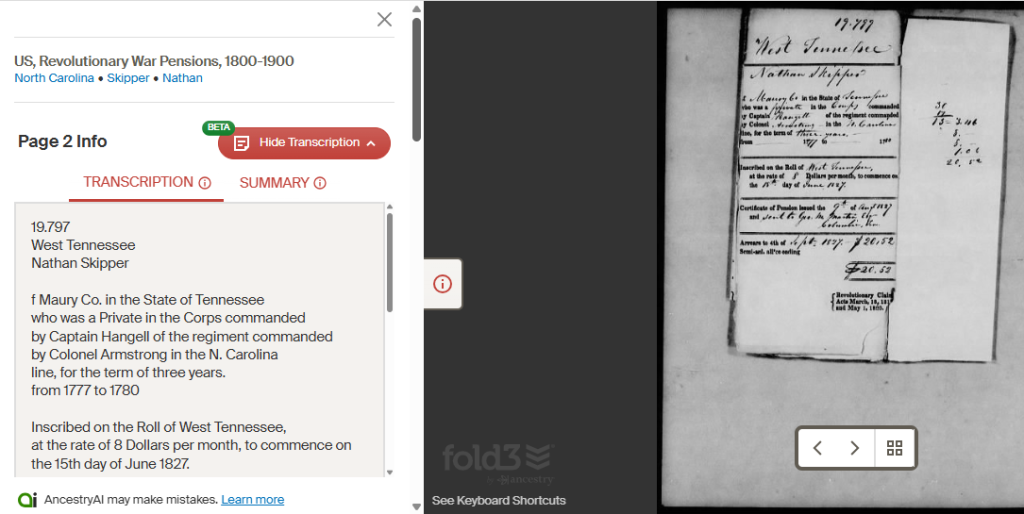
As I logged onto the pension for my Revolutionary War grandfather–Nathan Skipper–I was pleased to find that the AI-based transcription is fully integrated into the platform…no clicking into a new browser needed. Off to the left-hand side of the screen, I could access the transcription and even an AI-provided summary of the document. While the ease of use is impressive, the words beneath the transcription and summary, stating that “AncestryAI may make mistakes,” is where my main interest and concern lies.
The AI Accuracy
My grandfather Nathan Skipper’s pension–which I used to review Fold3’s full-text search–is difficult to read, what with the severe slant of the writing, the ink’s thickness, and the overall nature of the script that feels a bit more sloppy than some other handwriting I’ve reviewed. Because of that, I wasn’t sure just how well this latest Fold3 AI would perform, and the answer is a bit mixed.
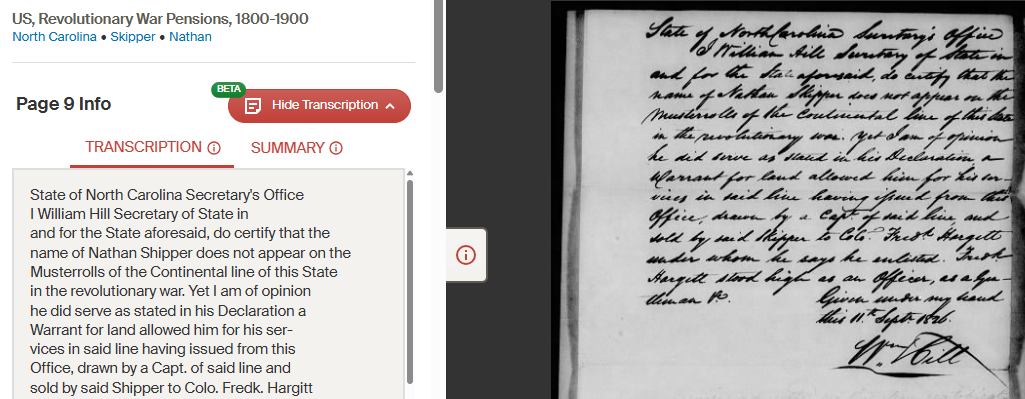
During my first few spot tests of Fold3’s latest offering, the transcription lined up well with my own analyses. While I was fairly impressed with the accuracy at first, that certainly doesn’t mean everything is accurate. There were a few words that, while I couldn’t fully decipher them, didn’t make sense per Fold3’s transcriptions, in which case I wish the word [illegible] was an option (note: maybe the word “illegible” is used by AI for impossible-to-decipher words, but I never found it during my spot tests). As the test continued, Fold3’s ability to decipher the text got even worse, as I’ll explain in the next paragraph. What’s more, don’t expect full accuracy with names, either. Even though the records pertained to Nathan Skipper–so his name appears often in both the handwritten text and information shared by Fold3–the transcription sometimes missed the mark with his name, once even calling him “Nathaniel Fisher” when it clearly read “Skipper.”
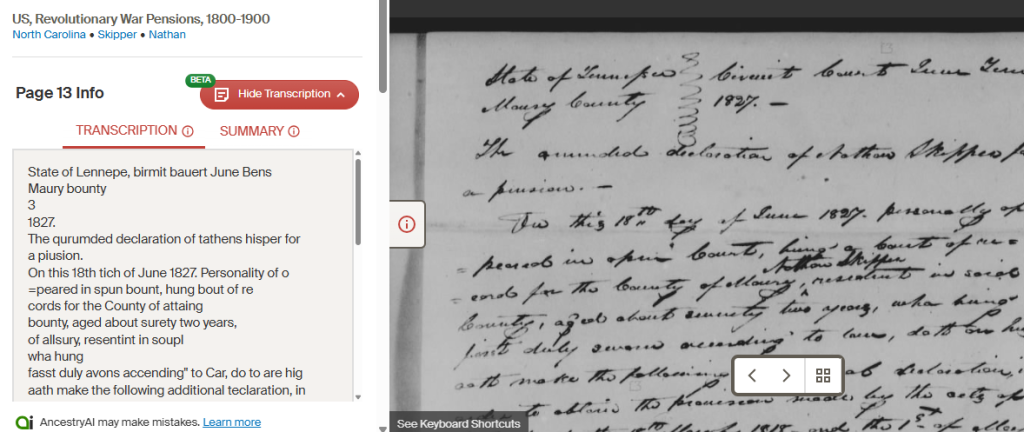
And while everything seemed to be going fairly well transcription-wise during the beginning of my spot tests, the final page of my grandfather’s pension (pictured above) was a complete and utter mess. Considering my previous experience with the Fold3 transcription, I anticipated other pages to perform similarly well, but that was obviously too lofty an idea. The final page–as shown above–is filled with a bunch of random letters that don’t even make up coherent words. Plus, the long S is apparently unable to be deciphered by Fold3’s AI platform, as “Tennessee” turned into “Leneppe.” Since Revolutionary War documents were often written by individuals who still used the long S, this feels like a bit of an oversight on Fold3’s part. Even easy-to-decipher words, like “Circuit Court,” were a mess in the transcription I’ve shared above.
What’s more, when there are blank spaces on any forms, Fold3 doesn’t denote those blank spaces, which can make the record read a bit more disjointed. As for the summaries, those could be helpful if you’re searching for someone in a pinch, but the summaries are relying on the accuracy of the transcription. As such, it’d only take a wrongly transcribed word or two to negatively impact the AI summary. Example: the image I shared above–which is one of the worst attempts at a transcription I’ve ever seen–says, “The individual, identified as Staten Lennepe…” Due to the messy, inaccurate transcription, the state of Tennessee somehow morphed into an individual’s name per the summary.
The Final Verdict
When it comes to Fold3’s AI-based full text searches, I have to admit that I started out fairly impressed. That said, the transcription quickly went downhill with the final page of my grandfather’s pension, in which completely coherent words (at least in the handwritten version) morphed into senseless letters in the AI transcription. That said, while there were still ample misses during my spot checks, the fact that handwritten texts can be transcribed at all is a technological marvel that just wasn’t fathomable to most researchers even a few years ago. Not to mention, one could argue that although this beta full text search had some mistakes (okay, tons of mistakes for some pages), human-crafted transcriptions can have errors, too.
While I was initially impressed with the accuracy before the transcriptions increased in inaccuracy, that doesn’t mean I’ll be stashing away my magnifying glasses just yet. For me personally, there’s nothing like diving into a completely undeciphered document and transcribing it word-for-word. By doing so, I also gain a better idea of my ancestor’s handwriting or the style of writing from the era my ancestors lived in. Although this is a personal decision for researchers, I don’t like the sterile, impersonal feel of trusting technology to fully analyze by ancestors’ pensions; since they fought for our nation, I feel privileged to take time out of my schedule to dive into their military files. Not to mention, as I’ve shown during some previous examples, you can’t fully rely on this technology because some pages will be transcribed in ways that make no sense, at least at this point in the technology (which, admittedly, is still in the beta phase).
No matter whether you plan to take advantage of Fold3’s full text searches because of their marginal accuracy or you like old-school transcribing, I definitely believe it’s a good idea to double-check the AI-provided transcriptions. For most researchers, it may be easier to decipher on their own before consulting Fold3’s transcriptions, simply so they aren’t swayed during the deciphering process. And whether you’re an AI aficionado or more anti-AI, Fold3 has shown us that even though genealogy means researching the past, it doesn’t exist in its own bubble–changing technologies might mean some changing research methods, too.
Happy Researching!

Disclaimer: TSGS and its team are not affiliated with Fold3. The views expressed in this post do not reflect the opinions and views of TSGS, board members, or society members.