
A while back, I provided a video with some tips for how Grammarly can improve your writing game when it comes to biographical sketches. Now, I’m back with a few tips for how to tackle those punctuation problems, giving you the tools to write a meaningful biography–with confidence!
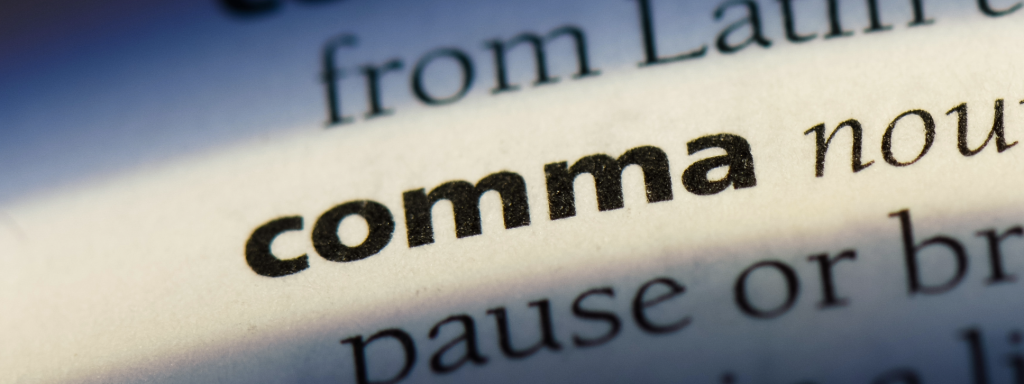
Oh, commas! Besides periods, they might be one of the most frequently-used pieces of punctuations–sometimes, they’re used even more than periods. (And did you catch that in this section already, there’ve been 4 commas?) Commas are an important part of writing, and chances are good that they’ll show up frequently in your biographical sketch. So let’s look at a few helpful rules of thumb when it comes to commas:
- Use a comma before and, but, or, for, and yet if they’re joining two independent sentences. (If you’re wondering what an independent sentence is, it means that it’s complete–it can stand on its own without being a fragment.) Here’s an example: My grandfather was a Civil War veteran, and he was a politician in the 1890s. Did you catch something here? The phrase “My grandfather was a Civil War veteran” is a complete, independent sentence, one I could put a period at the end of and then move on. The same is true for “he was a politician in the 1890s“–this is a complete, independent sentence. Because I wanted to join these two sentence together, I used a comma before and.
- When you referencing just a month and a year (i.e., September 2026), no comma is needed. But that doesn’t mean you never need a comma when you’re sharing a date! In fact, you should use commas when you’re referencing months, days, and years together. Here’s an example: The Battle of Shiloh was fought April 6 and 7, 1862, in Tennessee. Notice that a comma is present before and after the year.
- Chances are good that you’ll have a list of three or more items, ideas, or things at some point. That’s where the Oxford comma comes in handy! (Note that not everyone is team Oxford comma, but I think it helps sentences read more clearly: find a helpful Oxford comma article here). Here’s an example of when to use an Oxford comma: My grandmother was an activist, teacher, and housewife. Because there are three items in this list, I separated each with a comma. Have four or more items in a list? No worries, just keep using the comma between items/ideas.
When I’m writing biographical sketches, I feel like I use quotation marks a lot! There are some important things to keep in mind with quotation marks, though, and here are a few examples:
- Wondering when you should use quotation marks? I always like to use them when I’m doing something like: directly quoting an oral history interview, sharing information from a secondary source, or providing information from primary sources (censuses, letters, marriage records, birth certificates, etc.). What a quotation mark does is alert readers that this is information that you’re drawing from somewhere else, be it a family member, a history book, or a 1939 death certificate. Here’s an example of when you might use quotation marks: Jerome Adams wrote in his 1863 letter, penned from Alexandria, Virginia, that he was “enjoying good health and in wonderful spirits.” By using the quotation marks, I distinguish my own words (not quoted) from what Jerome Adams had to say. Sometimes, you might quote an entire sentence or multiple sentences, which could look like this: Adams wrote: “I’m doing well and enjoying good health and in wonderful spirits. I wish you would write me soon. Letters always brighten my spirit.“
- When you’re quoting, make sure you keep the punctuation inside of the quotation marks. I feel like I could probably repeat this again because it’s a common error I see, but the good news it that it’s also a super easy issue to correct. Here’s an example of what NOT to do: “Buell’s success turned the tides of the war”. See how that period is outside of the quotation marks? With the backspace button, we can easily correct this error. Here’s how the sentence should appear: “Buell’s success turned the tides of the war.” This simple grammatical fix can certainly elevate any biographical sketch!

While there are a lot of punctuation marks, we don’t have space to get in to all of them today (and if we talked about all punctuation marks and their uses, this might turn into a 200+ page writer’s manual), so let’s wrap up this post by discussing brackets and parentheses. When might you use brackets and parentheses? Here are some instances when these pieces of punctuation are a must-have:
- As a historian, I use brackets most frequently when I’m working with primary sources. When I’m transcribing an American Civil War soldier’s letter, for example, I’ll use a bracket with the word [sic] in it, which essentially alerts readers that the error is the soldier’s, not mine. (Here’s an interesting article about how to use [sic], plus the meaning behind the word.) Let’s take a look at a practical application for this word: In his letter to his wife, Sgt. Darius Carneal wrote, “whe [sic] had a grand time and never imagind [sic] we could eat so good while at war.” See those two misspelled words in the example? If I didn’t use [sic], someone might believe I made a typing error: because I used [sic], they know I didn’t. What happens if the same word is misspelled over and over? Well, reading [sic] a bunch of times in a sentence can be jarring, so that’s where [sic passim] comes in handy, essentially letting readers know that the word is misspelled throughout the document–but we’re just telling them about it once. Here’s an example: “Whe [sic passim] were marching when whe were overrun by the enemy, so whe darted for the bushes while whe had time.” Because I used [sic passim], I didn’t have to write [sic] four times, which saves time and makes reading this sentence a bit easier.
- You might also use brackets if you’re deciphering a document and there’s a word you either aren’t 100% sure about or can’t transcribe at all. Here’s an example of a transcription that I *thought* I had right but wasn’t completely sure about: Skipworth said in his 1932 letter: “Our trip went well and we had a [grand?] time.” Since I wasn’t 100% certain the word was “grand,” I plopped the word in brackets with a question mark, just to alert readers that this word may not be totally accurate. After all, one little word can change the entire meaning of a document, turning a vacation from a “grand” time to a “bland” time! Sometimes, there are words that–try as I might–are just too faded or illegible for me to read. Here’s what I do in that case: Skipworth said in his 1932 letter: “Our trip went well and we had a [illegible] time.” By placing the word “illegible” in brackets, it makes it clear to readers that there’s another word here that I just couldn’t decipher with certainty.
- And now let’s close off our discussion by briefly mentioning parentheses. One of my biggest uses for parentheses when I’m crafting biographical sketches is to use them to add in notes or share an idea that, while somewhat important, may not warrant its own sentence. Here’s an example of using parentheses for notes: When I spoke with Marjorie Wood, she said she was unaware of Ross Hamby having ever operated a farm stand (records show, however, that he operated a stand from 1981 to 1982). By using parentheses, I was able to concisely add in a note to accompany Marjorie’s statement. Now here’s an example of using parentheses to add in information that’s mildly important: When I talked with Cordelia Randolph (a phone interview that took place May 2026), she noted that her father worked in the coal mines during the Great Depression. Here, I use parentheses to share a bit of additional information. Do readers have to know when I spoke with Cordelia in order to comprehend the biographical sketch? Probably not, but I thought it could be an important detail to briefly include.

I hope that you now have a better grasp for how to navigate and implement commas, quotation marks, brackets, and parentheses in the next biographical sketch you’re crafting! I’ll also be sharing a few examples for navigating jargon in a future post, so stay tuned.
Keep the history alive!

Disclaimer: There a variety of different grammar rules that change based on the writing style (APA, MLA, Turabian/Chicago, etc.) and a variety of other factors. These tips are meant as a helpful resource only and are not intended to replace carefully editing of one’s work and doing additional research by using online/print grammar manuals.